 ≥99% Purity
 Third-Party Tested
 COA Available
 U.S.-Based
 Research Use Only
Blog
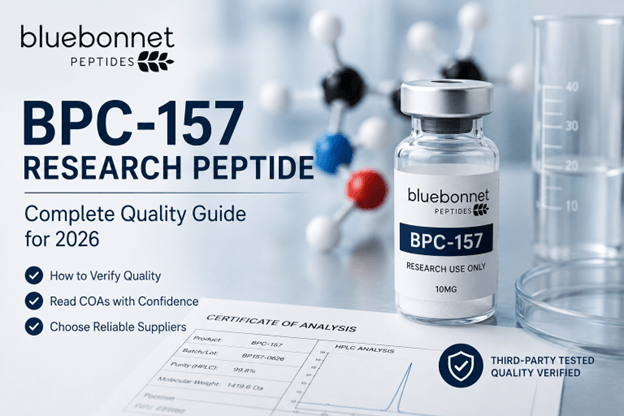
BPC-157 Research Peptide: Complete Quality Guide for 2026

Last updated: July 2026 | 7-minute read
BPC-157 quality is harder to verify than most suppliers want you to think. If you’re researching BPC-157, you’ve probably noticed something: every supplier claims to sell “research-grade” peptides, but the quality documentation varies wildly. For example, some provide detailed third-party testing. Others, however, offer vague manufacturer claims. And in many cases, some don’t provide documentation at all.
This guide cuts through the noise. Specifically, we’ll cover how to verify BPC-157 quality, what to look for in a Certificate of Analysis, and how to identify suppliers worth trusting with your research.
What Is BPC-157?
BPC-157 is a synthetic peptide derived from a protective protein found in human gastric juice. In other words, the name stands for “Body Protection Compound-157.” As a result, it’s a 15-amino-acid sequence that researchers have studied extensively in laboratory and animal research settings.
Key specifications:
- Amino acid sequence: 15 amino acids
- Molecular formula: C₆₂H₉₈N₁₆O₂₂
- Molecular weight: ~1,419 Da
- Common research dosages: 5mg, 10mg vials
BPC-157 carries a Research Use Only (RUO) classification. In practice, this means researchers intend it exclusively for in-vitro research and laboratory applications, not for human consumption, therapeutic use, or diagnostic purposes. Learn what Research Use Only actually means.
Why BPC-157 Quality Matters
In research settings, quality directly impacts outcomes. For instance, if the peptide you’re studying isn’t what it claims to be, if the purity falls below stated levels, if contamination is present, or if the compound is wrong entirely, your research results become meaningless.
This is why verification matters. Furthermore, the peptide market has a well-documented quality problem that researchers need to understand before purchasing.
Common quality issues in the peptide market:
- Purity misrepresentation: A supplier claims ≥99% purity based on manufacturer data, but independent testing reveals 85% or lower
- Contamination: Heavy metals, bacterial endotoxins, or even fentanyl in poorly sourced products
- Wrong compound: What’s labeled as BPC-157 is actually a different peptide or compound
- Degradation: Improper storage or shipping damages the peptide before it reaches you
Ultimately, independent third-party testing is the only reliable way to verify what’s actually in the vial.
How to Verify BPC-157 Quality: The Certificate of Analysis
A Certificate of Analysis (COA) is your primary verification document. However, not all COAs carry the same weight. Moreover, the difference between a real COA and a recycled one can completely invalidate your research. Here’s what a real COA looks like.
What a Real COA Includes
1. Independent Lab Name
The lab conducting the analysis should meet three criteria:
- Independent: No financial relationship with the peptide manufacturer or supplier
- Accredited: Certified by organizations like A2LA (American Association for Laboratory Accreditation) or ISO 17025
- Verifiable: You should be able to look up the lab online and confirm their accreditation status
Red flag: The COA comes from the same company that manufactured the product. In that case, it’s self-certification, not independent verification.
2. Testing Method: HPLC
High-Performance Liquid Chromatography (HPLC) is the gold standard for peptide purity testing. Specifically, it separates the components of a sample and measures the concentration of each. For peptides, therefore, this tells you:
- What percentage of the sample is the target peptide (BPC-157)
- What percentage consists of impurities, degradation products, or other compounds
What to look for on the COA:
- Testing method listed as “HPLC” or “RP-HPLC” (Reverse-Phase HPLC)
- Purity percentage: Should be ≥99% for research-grade peptides
- Chromatogram: The visual graph showing the HPLC results (peak should be clean and well-defined)
3. Mass Spectrometry Confirmation
In addition to HPLC, mass spectrometry confirms identity, meaning that the compound is actually BPC-157 and not something else entirely. Specifically, mass spec measures the molecular weight of the sample. For BPC-157, therefore, researchers expect a molecular weight of approximately 1,419 Da.
What to look for:
- Mass spec results showing molecular weight matching BPC-157
- Confirmation of amino acid sequence (some labs provide peptide mapping)
4. Lot Number Matching
The lot number (or batch number) on the COA must match the lot number printed on your vial. This matters because suppliers can recycle or falsify COAs. Consequently, matching lot numbers prove the document corresponds to the specific batch you received.
How to verify:
- Check the vial label for a lot/batch number
- Compare it to the lot number on the COA
- If they don’t match, contact the supplier immediately
5. Fentanyl Screening
Fentanyl contamination has appeared in research chemicals sourced from unverified overseas manufacturers. Fortunately, a fentanyl screen is a simple, inexpensive test that shows the supplier takes safety seriously.
What to look for:
- Fentanyl test result listed on COA
- Should read “Not Detected” or “Negative”
Red flag: No fentanyl screening appears on the COA. As a result, that absence tells you something important about how the supplier approaches contamination risks.
How to Verify COA Authenticity
Even a well-formatted COA can be faked. Therefore, here’s how to verify authenticity before you trust any document:
Step 1: Look up the lab
First, Google the lab name listed on the COA and visit their website. Then confirm:
- The lab exists and operates currently
- They offer peptide testing services
- Their accreditation remains active
Step 2: Check accreditation
Next, visit the American Association for Laboratory Accreditation (A2LA) directory. Then search for the lab name and confirm their accreditation status and scope.
Step 3: Contact the lab if necessary
Finally, if doubts remain about a COA’s authenticity, contact the testing lab directly:
- Provide the lot number and COA date
- Ask if they can confirm the document came from their facility
- Legitimate labs will verify or deny authenticity without hesitation
Red Flags: When to Walk Away
🚩 No COA provided
If a supplier doesn’t provide a COA, or only offers one “upon request” after you’ve already purchased, walk away. In 2026, providing batch-specific COAs should be standard practice, not an afterthought.
🚩 Manufacturer-provided testing only
If the same company that manufactured the peptides also issued the COA, that’s not independent verification. Instead, it’s a company grading its own homework.
🚩 Missing testing method
If the COA doesn’t specify the testing method (e.g., “HPLC”), there’s no way to know how purity was measured or whether the method is reliable.
🚩 Purity below 95%
Research-grade peptides should test at ≥99% purity. Therefore, if results show 90%, 85%, or lower, the product isn’t suitable for serious research work.
🚩 No lot number or mismatched lot numbers
If the COA lacks a lot number, or the numbers don’t match your vial, the document most likely doesn’t correspond to your batch.
🚩 Suspiciously low pricing
BPC-157 with legitimate third-party testing costs a certain amount to produce. Consequently, if a supplier’s pricing is 50% lower than competitors, they’re cutting corners somewhere in the process.
Bluebonnet Peptides BPC-157 Quality Standards
At Bluebonnet Peptides, every batch of BPC-157 goes through independent third-party testing before we list it for sale.
Our process:
- We manufacture BPC-157 at an ISO-certified facility
- We then send each batch to an independent, accredited lab for analysis
- HPLC testing confirms ≥99% purity
- Subsequently, mass spectrometry confirms molecular identity
- Fentanyl screening confirms no contamination
- Finally, we publish the batch-specific COA and keep it publicly accessible
We don’t ask you to trust us. Instead, we ask you to verify the data.
How to Store BPC-157 Properly
Even high-quality BPC-157 can degrade if you store it improperly. As a result, following proper storage protocol protects the integrity of your research.
Unopened vials:
- Store at -20°C to -80°C (freezer storage)
- Keep in original packaging to protect from light
- Avoid repeated freeze-thaw cycles
Reconstituted peptides:
- Store at 2°C to 8°C (refrigerator)
- Use within 30 days of reconstitution
- Protect from light (wrap vial in foil if necessary)
- Do not freeze after reconstitution
Shipping considerations:
- BPC-157 should arrive with cold packs or ice packs
- Verify the supplier uses temperature-controlled shipping
- If the package arrives warm, contact the supplier immediately
How to Choose a BPC-157 Supplier
Here’s a simple checklist to guide your decision:
- ✅ Third-party COA available for every batch, linked directly from the product page, not just “available upon request”
- ✅ Independent lab testing from a verifiable, accredited lab, not manufacturer self-testing
- ✅ HPLC and Mass Spec testing confirming both purity and identity
- ✅ Fentanyl screening treated as standard, not optional
- ✅ Lot number on COA matches vial label
- ✅ Transparent pricing that reflects legitimate testing costs
- ✅ Clear Research Use Only compliance with no therapeutic claims or health benefits listed
- ✅ Responsive support for COA questions, storage guidance, and technical documentation
Final Thoughts
Choosing a BPC-157 supplier isn’t about finding the cheapest price or the fastest shipping. Instead, it’s about finding verifiable quality you can rely on.
Third-party testing isn’t a luxury. In fact, it’s the baseline. In research, you can’t afford to question whether the compound you’re studying is what it claims to be. As a result, independent verification removes that doubt entirely.
Same peptide name. Very different documentation. It’s worth knowing the difference.
If you’re still getting familiar with the basics, what are peptides is a good starting point. Additionally, if you want to understand the RUO designation in full, the Research Use Only post covers that in detail. You can also explore our full Recovery Research range, including the BPC-157 TB-500 blend.
Related Reading:
Research Use Only · Not for Human Consumption · Educational Purposes Only
Bluebonnet Peptides provides research-grade peptides to qualified investigators and institutions. All products are for laboratory research use only and are not intended for human consumption, veterinary use, or therapeutic applications.

Related posts
Third-Party Peptide Testing | HPLC, Mass Spec & Lab Verification
How to Choose a Research Peptide Supplier: 2026 Buyer’s Guide
BPC-157 Research Peptide: Complete Quality Guide for 2026
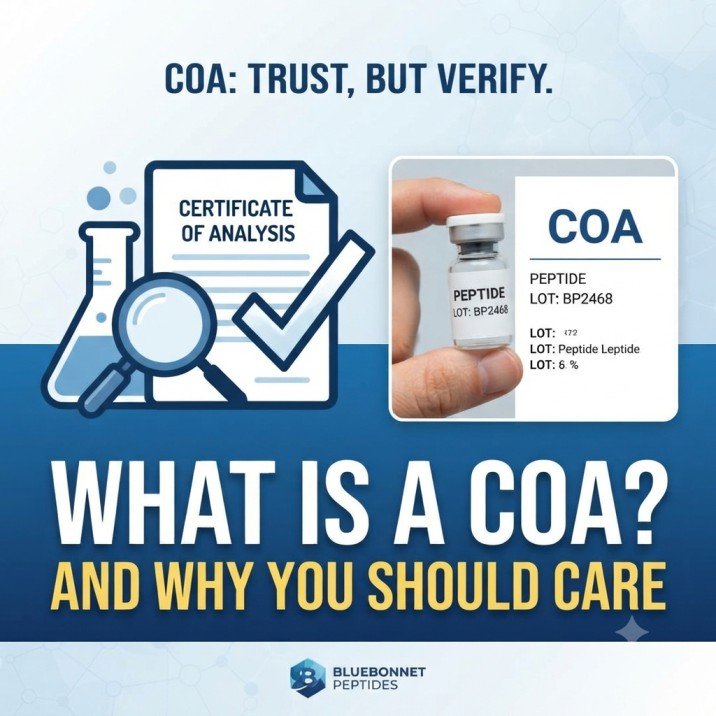
Certificate of Analysis | What a Real COA Looks Like
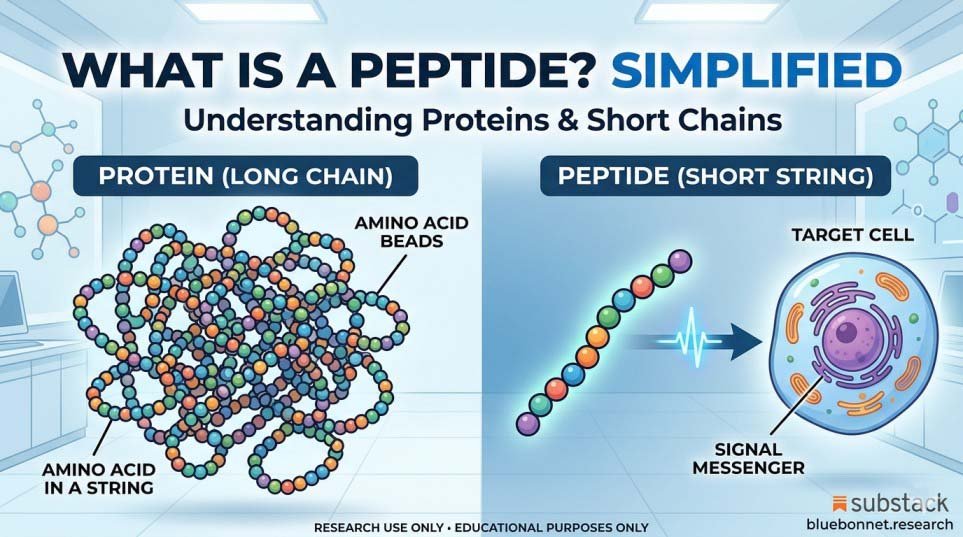
Nobody Explained Peptides to Me Either. So Here’s My Best Shot
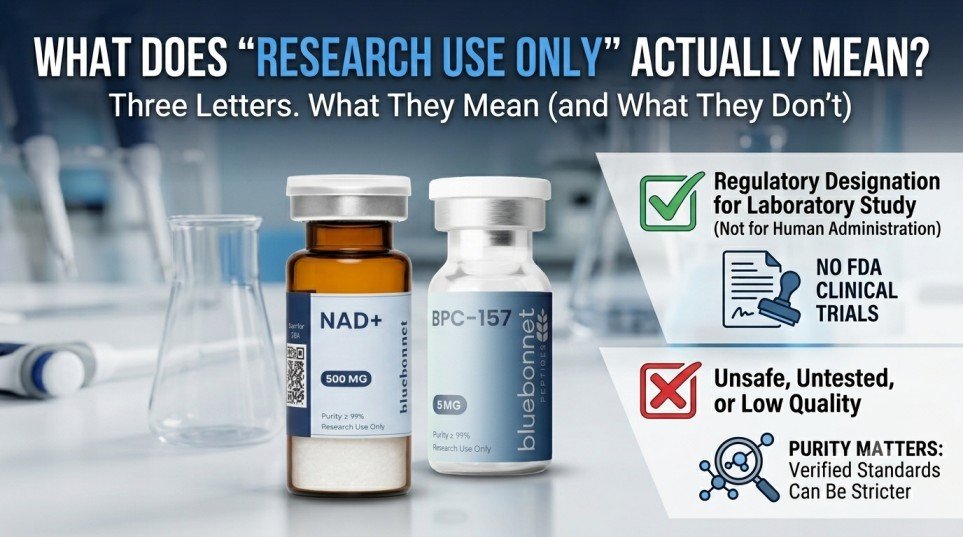
Research Use Only | Bluebonnet Peptides
Product categories
Top rated products
-
 Ipamorelin CJC-1295 / IPA Rated 5.00 out of 5$75.00
 -
 DSIP
$40.00
DSIP
$40.00
-
 MOTS-C
$60.00 – $160.00Price range: $60.00 through $160.00
MOTS-C
$60.00 – $160.00Price range: $60.00 through $160.00