 ≥99% Purity
 Third-Party Tested
 COA Available
 U.S.-Based
 Research Use Only
Blog
Third-Party Peptide Testing | HPLC, Mass Spec & Lab Verification

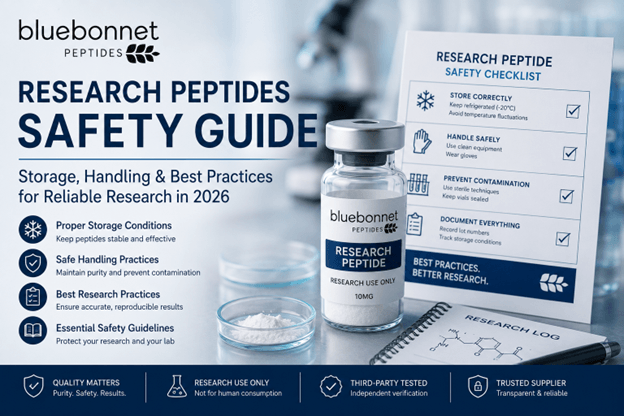
Last updated: July 2026 | 8-minute read
Third-party peptide testing is a phrase you see on every peptide supplier’s website. It’s become marketing shorthand for quality. However, what does it actually mean? And more importantly, how do you verify it’s real?
Not all third-party peptide testing is created equal. For instance, some suppliers send samples to independent, accredited labs and publish the results openly. Others, by contrast, use vague manufacturer claims or recycle old COAs. And in many cases, some don’t test at all — they just say they do.
This guide, therefore, explains how third-party peptide testing works, what testing methods matter, and how to verify the results are real.
What Is Third-Party Peptide Testing?
Third-party peptide testing means an independent laboratory with no financial relationship to the manufacturer or supplier analyzes the product and issues a report.
Why independence matters: if the company that made the peptides also tests the peptides, there’s a conflict of interest. Specifically, they have a financial incentive for the product to pass. A third-party lab, however, has no stake in the outcome. They test the sample, report the results, and issue a Certificate of Analysis (COA) based on data, not sales goals. Here’s what a real COA looks like.
Real third-party peptide testing:
- ✅ Independent lab with no relationship with manufacturer or supplier
- ✅ Accredited by organizations like A2LA or ISO 17025
- ✅ Verifiable — you can look up the lab and confirm accreditation
- ✅ Batch-specific — each lot tested separately
Not third-party testing:
- ❌ Manufacturer self-testing
- ❌ In-house testing by the supplier
- ❌ Generic or recycled COAs from old batches
- ❌ COAs without lab name or accreditation info
Why Third-Party Peptide Testing Matters
In research, the quality of your compound directly determines the reliability of your results. For example, if you’re studying a peptide and the purity is 85% instead of the claimed 99%, your research outcomes are compromised. Furthermore, if the peptide is contaminated, degraded, or mislabeled, your results become meaningless entirely.
Third-party peptide testing answers three critical questions:
1. Is this the correct peptide?
- Mass spectrometry confirms molecular identity
- Verifies the compound matches the label (e.g., BPC-157 is actually BPC-157)
2. How pure is it?
- HPLC measures purity percentage
- Tells you how much of the sample is the target peptide versus impurities
3. Is it contaminated?
- Fentanyl screening, heavy metals testing, endotoxin testing
- Verifies the sample is free of harmful contaminants
Without third-party peptide testing, you’re trusting the supplier’s word. With it, however, you have verifiable data.
The Two Critical Third-Party Peptide Testing Methods: HPLC and Mass Spectrometry
HPLC: Measuring Purity in Third-Party Peptide Testing
HPLC (High-Performance Liquid Chromatography) is the gold standard for peptide purity analysis. Specifically, here’s how it works:
- First, a sample is dissolved in a liquid solvent
- The sample is then forced through a column under high pressure
- Different compounds in the sample separate based on their chemical properties
- A detector subsequently measures the concentration of each compound
- Finally, the results display as a chromatogram — a graph showing peaks for each compound
What HPLC tells you:
- Purity percentage: What percentage of the sample is the target peptide
- Impurities: What other compounds are present (degradation products, synthesis byproducts)
- Consistency: Whether the sample matches expected specifications
Reading an HPLC chromatogram: on a COA, you’ll see a graph with peaks. Each peak represents a compound detected in the sample. The main peak should be the target peptide (e.g., BPC-157), while smaller peaks, by contrast, represent impurities or degradation products.
What to look for:
- One dominant, well-defined peak (the target peptide)
- Peak area percentage ≥99% (research-grade standard)
- Minimal or no secondary peaks (indicates low impurity levels)
Red flags:
- ❌ Multiple large peaks (indicates high impurity levels)
- ❌ Purity below 95%
- ❌ No chromatogram provided (can’t verify purity visually)
Mass Spectrometry: Confirming Identity in Third-Party Peptide Testing
Mass spectrometry (mass spec) confirms the molecular identity of the peptide. In other words, HPLC tells you how pure the sample is, while mass spec tells you what the sample actually is.
How it works:
- First, the sample is ionized (given an electrical charge)
- Ions are then separated based on their mass-to-charge ratio
- The detector subsequently measures the molecular weight of the ions
- Finally, the results confirm whether the molecular weight matches the expected peptide
What mass spec tells you:
- Molecular identity: Is this actually BPC-157, or is it a different peptide?
- Molecular weight: Does the weight match the expected value for BPC-157 (~1,419 Da)?
- Sequence confirmation: Advanced mass spec can verify the amino acid sequence
Why this matters: two different peptides could produce similar HPLC results if they have similar purity levels. However, they have different molecular weights. As a result, mass spec confirms you’re getting the correct peptide, not a substitution or mislabeled product.
What to look for on the COA:
- Mass spec results showing molecular weight
- Expected molecular weight for the peptide (e.g., BPC-157 = ~1,419 Da)
- Confirmation that observed weight matches expected weight
Red flags:
- ❌ No mass spec data provided
- ❌ Molecular weight doesn’t match expected value
- ❌ COA only lists HPLC without confirming identity
Additional Third-Party Peptide Testing: Contamination Screening
Purity and identity testing confirm what the peptide is and how pure it is. Contamination testing, however, confirms what it isn’t — harmful substances that shouldn’t be there.
Fentanyl Screening
Fentanyl is a synthetic opioid that has appeared in research chemicals sourced from unverified overseas manufacturers. Fortunately, it’s a simple, inexpensive test, and its presence on the COA shows the supplier prioritizes safety. Its absence, by contrast, is a red flag.
What to look for:
- Fentanyl test result listed on COA
- Should read “Not Detected,” “Negative,” or “< LOD” (below limit of detection)
Heavy Metals Testing
Heavy metals like lead, mercury, arsenic, and cadmium can be present in peptides produced in facilities with poor quality control. Moreover, their presence indicates poor manufacturing standards and can interfere with research outcomes directly.
What to look for:
- Heavy metals panel results (lead, mercury, arsenic, cadmium)
- Levels should be below regulatory limits
- Often listed as “< LOQ” (below limit of quantification)
Bacterial Endotoxin Testing
Endotoxins are toxins released by bacteria. They can contaminate peptides if manufacturing facilities aren’t sterile. As a result, their presence can significantly affect cell culture and animal research outcomes.
What to look for:
- Endotoxin test results (measured in endotoxin units, EU/mg)
- Should be below regulatory limits (typically < 10 EU/mg)
How to Verify Third-Party Peptide Testing Is Real
Not all COAs are legitimate. In fact, some are recycled, outdated, or fabricated. Therefore, here’s how to verify authenticity before you trust any document.
Step 1: Look Up the Lab
First, Google the lab name listed on the COA and visit their website. Then verify:
- The lab exists and is operational
- They offer peptide testing services
- Their accreditation is current
Red flags:
- ❌ Lab name isn’t searchable
- ❌ No website or online presence
- ❌ Lab name is generic or vague
Step 2: Check Lab Accreditation
Next, independent labs should carry accreditation from organizations like A2LA (American Association for Laboratory Accreditation) or ISO 17025. Specifically, you can verify this by visiting the A2LA directory, searching for the lab name, and confirming their accreditation status and scope.
Red flags:
- ❌ Lab isn’t listed in accreditation directories
- ❌ Accreditation is expired or inactive
- ❌ No accreditation information provided on COA
Step 3: Match Lot Numbers
Subsequently, the lot number on the COA must match the lot number on your vial. This matters because COAs can be recycled or falsified. Consequently, matching lot numbers prove the COA corresponds to your specific batch.
How to verify:
- Check the vial label for a lot/batch number
- Compare it to the lot number on the COA
- If they don’t match, contact the supplier immediately
Red flags:
- ❌ No lot number on vial
- ❌ No lot number on COA
- ❌ Lot numbers don’t match
Step 4: Contact the Lab If Necessary
Finally, if doubts remain about a COA’s authenticity, contact the testing lab directly. Legitimate labs will verify or deny the COA’s authenticity and provide additional documentation if requested.
What to do:
- Find the lab’s contact information (phone or email)
- Provide the lot number and COA date
- Ask if they can confirm the document came from their facility
Red flags:
- ❌ Lab doesn’t respond
- ❌ Lab says they didn’t issue the COA
- ❌ Supplier discourages you from contacting the lab
What “Research-Grade” Purity Actually Means
Research-grade standard means ≥99% purity. In other words, at least 99% of the sample is the target peptide, while the remaining less than 1% consists of acceptable impurities such as degradation products or synthesis byproducts.
Why 99% is the standard: in research, even small variations in purity can affect outcomes. Higher purity means, therefore, more consistent results, fewer confounding variables, and better reproducibility.
Purity tiers:
- ≥99%: Research-grade (acceptable for scientific research)
- 95-98%: Lower-grade (may be suitable for preliminary studies, but not ideal)
- Below 95%: Not research-grade (too many impurities for reliable results)
Red flags:
- ❌ Suppliers selling 90%, 85%, or lower purity peptides as “research-grade”
- ❌ No purity percentage listed
- ❌ Vague claims like “high purity” without data
How Bluebonnet Peptides Approaches Third-Party Peptide Testing
At Bluebonnet Peptides, third-party peptide testing isn’t optional. Instead, it’s standard practice for every batch across our full range, including BPC-157, TB-500, and our complete Recovery Research range.
Our process:
- Every batch is manufactured at ISO-certified facilities
- Samples are then sent to independent, accredited third-party labs
- HPLC confirms ≥99% purity
- Subsequently, mass spectrometry confirms molecular identity
- Fentanyl screening confirms no contamination
- Finally, the batch-specific COA is published and remains publicly accessible from every product page
We don’t ask you to trust us. Instead, we provide the data so you can verify independently.
Common Questions About Third-Party Peptide Testing
Q: Why don’t all suppliers use third-party peptide testing?
A: Third-party testing costs money. Specifically, each batch sent to an independent lab costs $200-$500+ depending on the testing scope. Consequently, suppliers who skip this step can offer lower prices, but the quality isn’t verifiable.
Q: How often should batches be tested?
A: Every batch should be tested independently. In fact, batch-to-batch variation is common in peptide manufacturing. Therefore, testing one batch and assuming the next is the same isn’t reliable.
Q: Can I request the original COA from the lab?
A: Yes. Legitimate suppliers should be able to provide the original COA directly from the lab. If they can’t, or if they discourage you from verifying, that’s a red flag.
Q: What if the COA is outdated?
A: COAs should correspond to current batches. If a supplier is using a COA from months or years ago, it doesn’t prove the current batch meets the same standards. Always, therefore, check the COA date and lot number.
Final Thoughts on Third-Party Peptide Testing
Third-party peptide testing is the difference between verifiable quality and blind trust. Specifically, HPLC confirms purity, mass spectrometry confirms identity, and contamination screening confirms safety. Together, therefore, they provide the data you need to trust your research compound.
Independent verification isn’t a luxury. In fact, it’s the baseline. In research, you can’t afford to wonder whether the peptide you’re studying matches its label. As a result, third-party peptide testing removes that question entirely.
Same peptide name. Very different verification. It’s worth knowing the difference.
Additionally, if you want to go deeper, the related reading below covers the key areas:
- What Is a Certificate of Analysis?
- How to Choose a Research Peptide Supplier
- BPC-157 Research Guide: Quality Standards
Research Use Only · Not for Human Consumption · Educational Purposes Only
Bluebonnet Peptides provides research-grade peptides to qualified investigators and institutions. All products are for laboratory research use only and are not intended for human consumption, veterinary use, or therapeutic applications.

Related posts
Third-Party Peptide Testing | HPLC, Mass Spec & Lab Verification
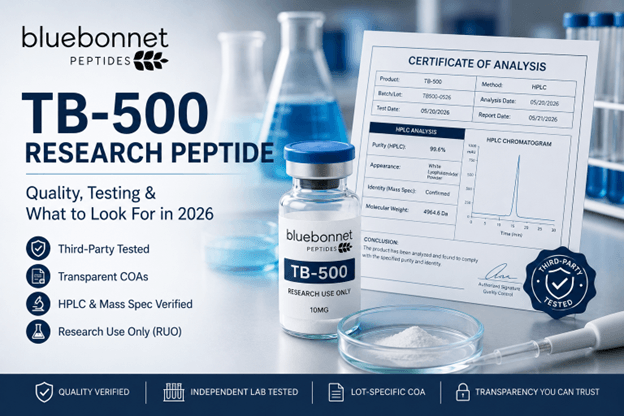
How to Choose a Research Peptide Supplier: 2026 Buyer’s Guide
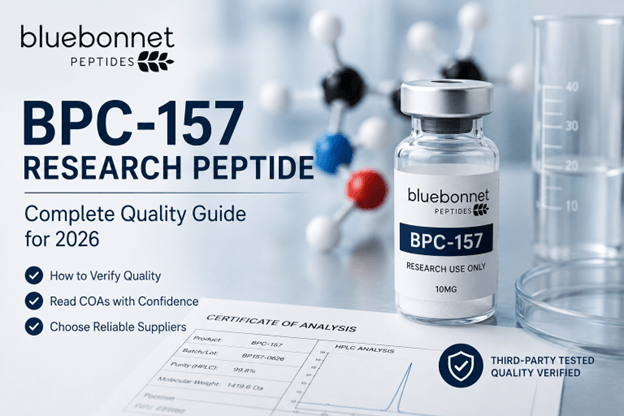
BPC-157 Research Peptide: Complete Quality Guide for 2026
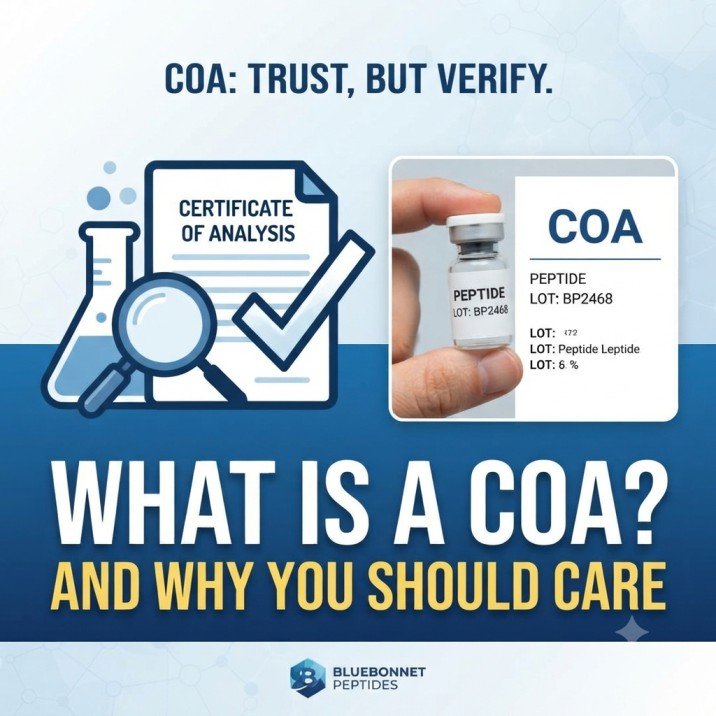
Certificate of Analysis | What a Real COA Looks Like
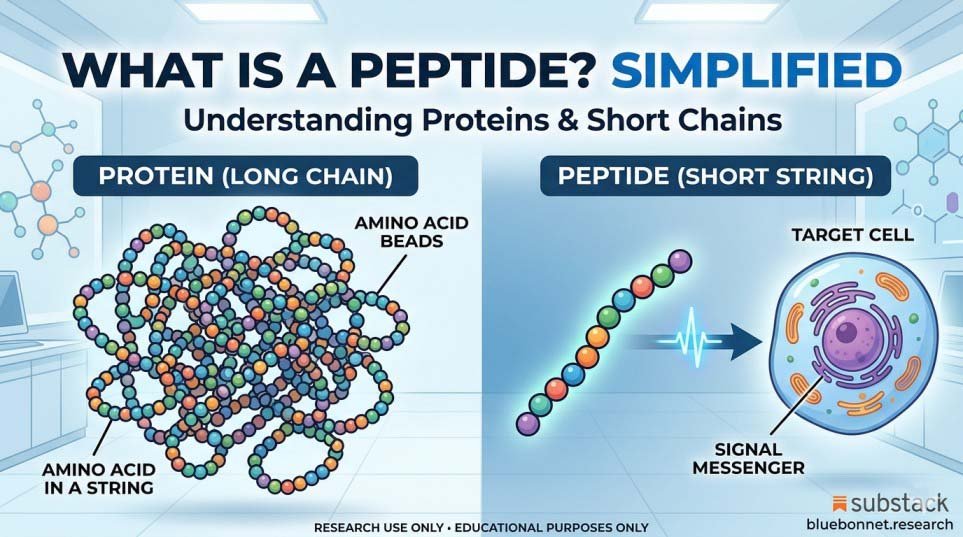
Nobody Explained Peptides to Me Either. So Here’s My Best Shot
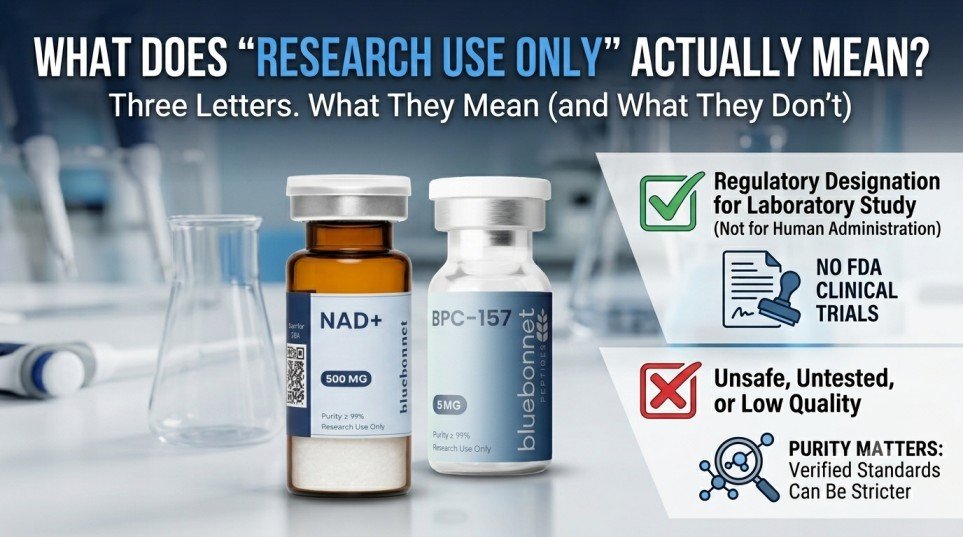
Research Use Only | Bluebonnet Peptides
Product categories
Top rated products
-
 Ipamorelin CJC-1295 / IPA Rated 5.00 out of 5$75.00
 -
 DSIP
$40.00
DSIP
$40.00
-
 MOTS-C
$60.00 – $160.00Price range: $60.00 through $160.00
MOTS-C
$60.00 – $160.00Price range: $60.00 through $160.00